

Clay Mask for Acne-Prone Skin: How to Choose a Gentle, Effective Fit
The most absorbent clay isn’t automatically the best choice for skin that’s prone to breakouts. If you’re considering a clay mask for acne-prone skin, it’s reasonable to wonder whether it will leave your complexion feeling tight, dry, or irritated, and whether its claims are more than persuasive packaging. A mask may help absorb excess oil and impurities, but it shouldn’t be expected to treat acne.
A considered approach is to choose by skin tolerance and routine fit, rather than by promises of a deeper cleanse. This guide will help you compare clay types, read product claims carefully, and decide whether a mask suits your skin’s needs. You’ll also find practical ways to use one thoughtfully and recognise when a moisturiser or sun-protection step may be more useful.
Along the way, we’ll look at what a blend of White Clay and Green Clay is described as offering, including in Maison Eloire Cosmetics Purifying Clay Mask - Pores & Blackheads. The aim is a calm, informed choice that supports your routine without asking a mask to do more than it can.
Key Takeaways
- Choose a clay mask for acne-prone skin by how your skin tolerates it and what role it can play in your routine, not by acne-treatment promises.
- Compare clay type, skin feel, fragrance information, and intended use, then check the full product label rather than relying on the product name.
- Match each step to a distinct need: a mask for oil and impurities, a moisturiser for hydration, or sunscreen for daytime protection.
- Use a cautious approach: follow the label, patch test as directed, and pay attention to how your skin responds.
- Consider a clay mask as one optional part of a balanced routine, alongside appropriate daily care.
What a Clay Mask for Acne-Prone Skin Can and Cannot Do
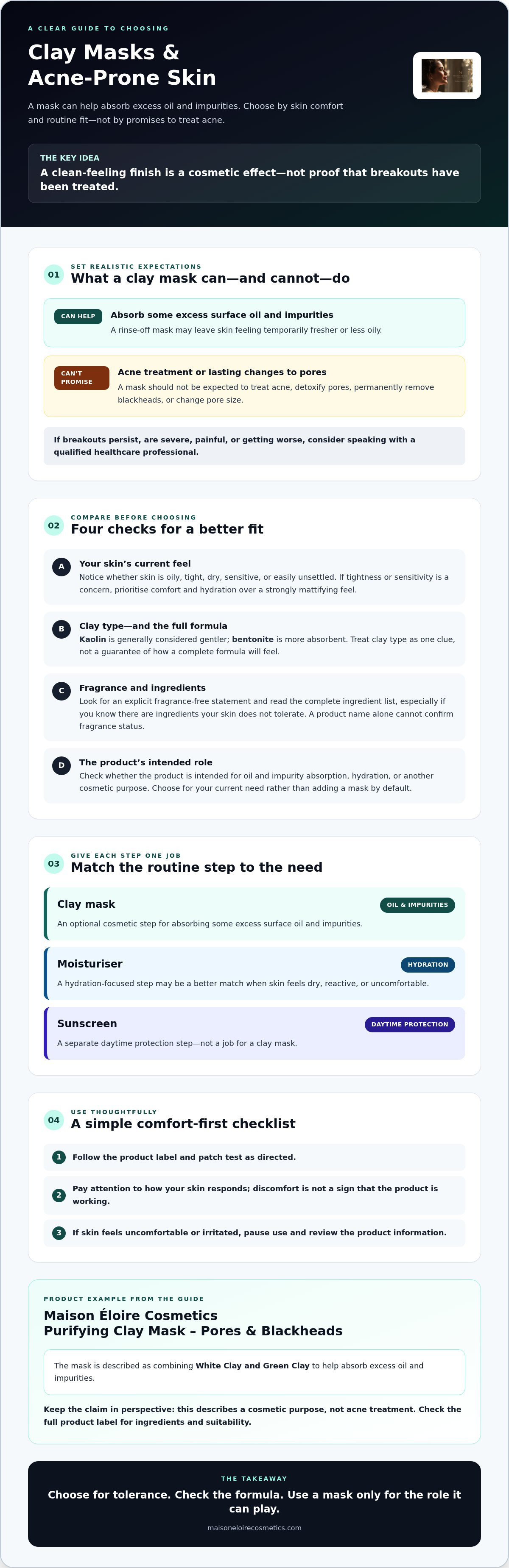
Wanting to manage visible oil and congestion without adding harsh steps is understandable. A clay mask is a rinse-off skincare product intended to provide a cosmetic benefit, such as absorbing some excess oil and impurities from the skin’s surface. It isn’t an acne treatment, and a clean-feeling finish doesn’t mean breakouts have been treated.
What clay masks are designed to do
Clay can help take up excess surface oil and impurities while the mask is in use. The history of medicinal clay spans different types and uses, but that history shouldn’t be taken as proof that a cosmetic mask treats acne. Maison Éloire Cosmetics’ Purifying Clay Mask - Pores & Blackheads combines White Clay and Green Clay and is described as helping absorb excess oil and impurities. That’s a cosmetic role, not a promise to detoxify pores, permanently remove blackheads, or change pore size.
A clay mask may temporarily cleanse the skin’s surface and absorb excess oil, but it doesn’t treat acne. If your skin feels fresher afterward, enjoy that as a temporary cosmetic effect rather than evidence that the cause of breakouts has been addressed. A clay mask for acne-prone skin is best considered an optional routine step, not a corrective treatment.
When acne-prone skin may need more than a mask
Occasional surface oiliness is different from breakouts that persist, feel painful, or are getting worse. A mask may suit someone seeking a fresh, less oily skin feel, but it shouldn’t be relied on to manage ongoing acne. Nor should discomfort be accepted as a sign that a product is working.
If acne concerns are persistent, severe, or causing pain, consider speaking with a qualified healthcare professional about appropriate care. A professional can help assess what may be contributing to the breakouts and discuss suitable options. Keep a mask in perspective: it can be one considered cosmetic step, but it doesn’t replace professional advice or care when those are needed.
As you assess any mask, pay attention to your skin’s response as well as its stated purpose. If it leaves your skin uncomfortable or irritated, pause use and review the product information. A gentle routine doesn’t need to rely on a strong, stripped feeling to seem effective.
How to Compare Clay Masks for Acne-Prone Skin
Oily skin isn’t the only kind of skin that can experience congestion. Your complexion may also feel dry, sensitive, or easily unsettled, so an “oily skin” label alone won’t tell you whether a mask is a comfortable fit. A suitable mask depends on formula, tolerance, and use, not skin labels alone.
Use the table as a starting point, then check the complete product label. A product name isn’t an ingredient list, and it can’t confirm fragrance status or tell you how your skin will respond.
| What to compare | What to look for | How it can guide your choice |
|---|---|---|
| Skin feel | Consider whether your skin is currently oily, tight, dry, or sensitive. | If tightness or sensitivity is already a concern, prioritise comfort and hydration over a strongly mattifying feel. |
| Clay type | Check which clays appear in the full ingredients. Kaolin is generally considered gentler, while bentonite is more absorbent; the complete formula still matters. | Use clay type as one clue, not a guarantee of how the mask will feel on your skin. |
| Fragrance information | Look for an explicit fragrance-free statement and review the ingredient list for anything you know your skin doesn’t tolerate. | Don’t assume a mask is fragrance-free because its name or packaging sounds simple. |
| Routine role | Check whether the product is intended for oil and impurity absorption, hydration, or another cosmetic purpose. | Choose the step that addresses your current need rather than adding a mask by default. |
Ingredients and claims worth checking
Read the complete ingredient list before purchasing, especially if you already know you’re sensitive to particular ingredients. Maison Éloire Cosmetics’ Purifying Clay Mask - Pores & Blackheads is described as combining White Clay and Green Clay to help absorb excess oil and impurities. Assess that stated cosmetic purpose separately from broader claims about acne or antibacterial effects. For context on established care options, see the Mayo Clinic’s overview of professional acne treatments.
Skin comfort, fragrance, and formula fit
Consider how your skin feels now, not only how you usually describe it. If it’s dry, reactive, or uncomfortable, a mask may not be the most useful next step; a simpler hydration-focused product may better match that need. Verify fragrance information on the product itself rather than assuming. To compare options by their stated purpose, explore Maison Éloire Cosmetics’ skincare selection at your own pace.
Clay Mask, Moisturizer, or Serum: Which Routine Step Fits?
Choose a skincare step by the need you want to address today. A mask, moisturiser, and sunscreen have different roles, so they aren’t interchangeable. A clay mask for acne-prone skin may suit a routine focused on excess oil and impurities, while hydration or daytime sun protection may be the more relevant priority.
| Routine need | Product type | Example of the role |
|---|---|---|
| Oil and impurities | Rinse-off clay mask | Purifying Clay Mask - Pores & Blackheads, with White Clay and Green Clay |
| Hydration | Moisturiser or overnight cream | A moisturiser chosen for its ingredients, directions, and fit with your skin |
| Daytime sun protection | Sunscreen | A daytime sunscreen selected for your needs and used according to its label |
When the Purifying Clay Mask may suit your routine
If you’re looking for a rinse-off step to help absorb excess oil and impurities, Maison Éloire Cosmetics’ Purifying Clay Mask - Pores & Blackheads may be an option to consider. Its formula combines White Clay and Green Clay, and its stated purpose is cosmetic. It isn’t a guaranteed solution for blemishes or blackheads, and it doesn’t take the place of daily skincare.
When hydration or sun protection is the priority
If your skin feels dry or tight, consider whether hydration is a more immediate need than oil absorption. A moisturiser or overnight cream may better fit that role. Check the product’s ingredients and directions, particularly if you have sensitive skin, and choose a formula that you already know your skin tolerates when possible. These products serve a different purpose from a clay mask.
For daytime, sunscreen is a separate sun-protection step, not an acne-specific product. A moisturiser or serum doesn’t replace a clay mask’s cosmetic oil- and impurity-absorbing role, just as a mask doesn’t replace hydration or daily sun protection. Let your current routine need guide the choice rather than adding every type of product at once.
To compare the options by their stated purpose, explore Maison Éloire Cosmetics’ skincare collection at your own pace.
How to Use a Clay Mask Without Overdoing It
A careful first use is less about following a universal schedule and more about following the directions for the specific product. Skin can respond differently, particularly if it’s already feeling dry or sensitive. Treat a clay mask for acne-prone skin as an occasional cosmetic step to introduce thoughtfully, not a reason to push through discomfort.
A careful first-use approach
Before opening the mask, review its current packaging directions and complete ingredient list. Check for ingredients you already know your skin doesn’t tolerate, and follow the product’s instructions for testing it on a small area before applying it more widely. A patch test can help you notice a reaction, though it can’t guarantee how your skin will respond over time.
For the first application, keep the rest of your routine familiar. Introducing several unfamiliar products at once makes it harder to identify what may be causing irritation. Follow the mask’s directions for where and how to apply it, how long to leave it on, and when and how to rinse. There isn’t one duration or frequency that suits every formula, so use the label rather than a general rule.
After masking: support comfort and consistency
Rinse as directed, then use familiar products that your skin already tolerates. Until you know how your skin responds, avoid adding other exfoliating or potentially irritating products in the same routine. Keep the next steps simple and observe how your skin feels afterward, rather than repeating the application quickly in search of a stronger effect.
Pay attention to discomfort. Persistent burning, marked redness, or uncomfortable tightness are reasons to rinse the product off if it’s still on your skin and pause further use. Don’t interpret irritation as proof that the mask is working. If the reaction continues, seek advice from a qualified healthcare professional. The same applies if your acne concerns worsen or remain difficult to manage.
Use the product label as your guide, and let your skin’s response inform whether the mask belongs in your routine. If you’re also reviewing other skincare steps, browse considered skincare essentials and compare options by their stated purpose.
Choosing Maison Éloire Skincare for a Balanced Routine
A considered routine starts with the need you want to address, not the number of steps you can add. For visible oil and impurities, hydration, sensitivity-conscious care, or daytime sun protection, choose products by their documented purpose and how they fit alongside the care you already use. A clay mask for acne-prone skin can be one optional cosmetic step, not a standalone acne solution.
A considered edit of relevant skincare options
Maison Éloire Cosmetics offers a Purifying Clay Mask - Pores & Blackheads for people considering a rinse-off mask in their routine:
- Purifying Clay Mask - Pores & Blackheads: combines White Clay and Green Clay and is described as helping absorb excess oil and impurities. Consider it if that cosmetic function suits your routine, without expecting it to treat acne or guarantee a change in blemishes or blackheads.
- Moisturiser: a separate routine step to consider when hydration is your priority. Check the individual product’s ingredients and directions to decide whether it suits your skin.
- Overnight cream: another possible hydration step. Review its full ingredient list and stated purpose, particularly if you know your skin reacts to specific ingredients.
- Sunscreen: a daytime sun-protection step, separate from a rinse-off mask or a moisturising product.
These products aren’t interchangeable. A mask’s stated role is different from hydration or daytime sun protection, and none should be treated as an acne treatment. Build around what your routine needs, rather than adding multiple products simply because they’re available.
A simple checklist before choosing
- Match the role: Is your current priority oil and impurities, hydration, sensitivity-conscious care, or daytime sun protection?
- Read the label: Review the complete ingredient list and directions, especially if your skin is reactive or sensitised. Don’t rely on the product name to infer ingredients or usage.
- Keep the routine measured: Introduce changes thoughtfully and pay attention to how your skin responds. If acne concerns persist or worsen, a cosmetic product isn’t a substitute for qualified professional advice.
A balanced routine can be simple, with each step earning its place through a clear purpose. Take time to compare the options and choose what aligns with your needs. Discover Maison Éloire’s skincare collection.
Choose the Routine That Feels Right for Your Skin
A thoughtful clay mask for acne-prone skin is chosen for its formula and fit, not for promises to clear acne. Keep its role modest: Maison Éloire Cosmetics’ Purifying Clay Mask - Pores & Blackheads combines White Clay and Green Clay to help absorb excess oil and impurities, while hydration and daytime protection remain separate routine needs.
Let your skin’s current comfort guide your next step. A moisturiser or overnight cream may be more relevant when your priority is hydration, while sunscreen is a separate daytime step. Check complete ingredient lists and directions, and pause if a product causes persistent discomfort. If acne concerns continue or worsen, seek qualified professional advice rather than expecting a cosmetic mask to address them.
Build a routine with care, adding only what answers a genuine need. Explore Maison Éloire’s skincare collection to consider the options at your own pace, and choose the steps that feel most appropriate for your skin.
Frequently Asked Questions
Is a clay mask good for acne-prone skin?
Some people with acne-prone skin may choose a clay mask for its stated cosmetic purpose, such as absorbing excess oil and impurities. Whether it suits you depends on the individual formula and your skin’s tolerance. Check the complete ingredient list, follow the product directions, and stop if it causes persistent discomfort. A mask doesn’t treat or prevent acne. For persistent or severe breakouts, seek advice from a qualified healthcare professional.
Can a clay mask make acne-prone skin dry or irritated?
Yes, dryness or irritation is possible, and your response can depend on both your skin and the formula. Oily skin can also be sensitive or dehydrated, so don’t assume that oiliness means your skin will tolerate a mask well. Follow the label, introduce one new product at a time, and pause use if you experience persistent burning, marked redness, or uncomfortable tightness. Ask a qualified professional about ongoing reactions.
How often should I use a clay mask on acne-prone skin?
There isn’t one frequency that suits every clay mask or every person. Follow the current product label, since directions depend on the formula, and pay attention to how your skin responds. Uncomfortable tightness or irritation is a reason to pause, not to use the mask more often. If you’re unsure how it fits your routine or have persistent skin concerns, ask a qualified healthcare professional for guidance.
What should I look for in a clay mask for acne-prone skin?
Compare the complete ingredient list, stated cosmetic purpose, directions, and any ingredients you know your skin is sensitive to. Maison Éloire Cosmetics’ Purifying Clay Mask - Pores & Blackheads is described as combining White Clay and Green Clay to help absorb excess oil and impurities. Those details describe its cosmetic role; they don’t establish that it treats acne. Don’t infer the full formula or suitability from a product name alone.
Should I moisturize after using a clay mask?
You can follow the mask’s directions and, if it suits your skin, continue with a familiar moisturiser. Check the moisturiser’s own directions and ingredients rather than assuming every combination will suit you. If a product causes discomfort, stop using it and consider seeking professional advice if symptoms persist.
Can I use a clay mask with niacinamide?
Compatibility depends on the individual formulas and your skin’s tolerance, so there’s no universal answer. Introduce products gradually, follow each label, and avoid adding several unfamiliar products to your routine at once. The ingredients in a particular moisturiser or serum don’t establish how your skin will respond alongside a particular mask. For ongoing irritation or questions about products used with acne treatment, consult a qualified professional.
Does a clay mask remove blackheads permanently?
No, a cosmetic clay mask shouldn’t be presented as a permanent blackhead solution or an acne treatment. Keep expectations aligned with that stated cosmetic purpose. If breakouts are persistent, painful, or worsening, seek advice from a qualified healthcare professional rather than relying on a mask.